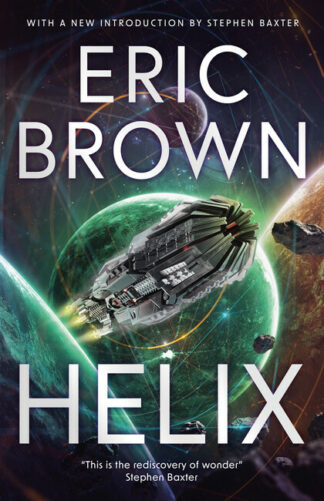
Following Eric Brown’s last impressive release, Helix, anticipation has been running high for months over what kind of form Kethani would take. As it turns out, it wasn’t what we were expecting at all... It’s a more subtle, more easily relatable story about the greatest event in our history through the eyes of a circle of friends not too dissimilar from ourselves... With a pantheon of infectiously likeable characters, Brown allows each of us to identify with someone, while his interpersonal drama is so exquisitely visualised that even the most emotionally detached reader will find their heartstrings being pulled at some points... This is surely one of Brown’s breakthrough stories, an achievement that highlights the extensive talents of an author destined, like his characters, for something far greater. A SciFi Now Must Read Now! *****
– James Rundle, SciFi Now
Readers of Sci-Fi, military fiction, and mystery will all find plenty to stimulate their imaginations in this fast-moving tale. Characters that come alive and all-too-believable technology move the plot along at breakneck speed. Thomas’s writing is smooth and swift, yet poetic, with a noir feel at times that enhances the darkest parts of his story: “When he came to himself he realized the procession had disappeared into the jungle like a train of ghosts.” There are unique elements, too, such as the benders, large airborne creatures that resemble jellyfish; their venom induces psychic trances that somehow transcend dimensions. Blue War is as multilayered as Bluetown itself, and utterly fascinating.
-- ForeWord
All you really need to know is that a benevolent alien race known as the Kéthani has landed on Earth offering immortality to humankind. As far as the process of resurrection which includes implants, nanotechnology, and a six-month instruction period on the planet Kéthan; the reason for the aliens’ gift—the official statement is so humans can work as ambassadors in bringing the word of the Kéthani to other races & planets—and the Kéthani themselves; very little is revealed with the book focusing instead on the sociological effect that immortality has on mankind.
In particular, “Kéthani” revolves around a group of friends—including a doctor, police officer, academic, high school teacher, professional cornet player, a Catholic priest, dry-stone waller, ferryman, and a writer—who hang out at a local pub in Oxenworth, England and the personal impact that the aliens have had on their lives with death, marriage and love the most prominent themes, although religion and philosophy are also represented.
From these stories, Eric Brown offers a deeply emotional and unforgettable glimpse at how the world might be changed if immortality, especially the Kéthani’s version of eternal life—people not only live forever, but come back healthier, younger and more humane with the allure of the stars at their fingertips—was suddenly in our grasp. Think about it. A world where the specter of death is banished, where suicide means a whole new beginning, where criminals and the terminally/mentally ill can have a second chance, where faith and the afterlife are challenged, and where maxims like “time heals all wounds” and “true love lasts forever” are given new perspectives…
It’s just an incredibly fascinating scenario and Eric does a spectacular job of exploring this concept in-depth, although I was left with several questions. For instance, after resurrection do you still grow old—I was just wondering because at least one resurrectee does—can you get injured or ill, and if you come back more humane so that crime is no longer an issue, wouldn’t you stop engaging in such destructive habits as drinking?
Writing-wise, Eric’s experience as an award-winning author is on full display in this book. The prose is graceful; the characters—with the exception of the narrative voices all sounding strangely the same—are rich and emotive; the storytelling is crafty and powerful; and even though “Kéthani” is essentially a series of old short stories linked together by a framing device, the novel flows along smoothly and ends on a high note, while teasing the reader with possibilities of another Kéthani tale :)
CONCLUSION: Last year I overlooked Eric Brown’s “Helix” and vowed not to make that same mistake with “Kéthani”. In return, I was rewarded with a brilliantly conceived and written novel about humanity that I’m going to be thinking about for a very long time. Utterly compelling, wonderfully thought-provoking and deeply moving, Eric Brown's "Kéthani" is a must-read...
-- Fantasy Book Critic
Kéthani grips from the very first page, creating a sense of wonder that makes you feel that you have stumbled onto something monumental, something very special indeed.
-- Interzone
The spirit of Bradbury is detectable, too, in Kethani's tone - its sense of the trans-cendent, its willingness to admit to wonder. The central premise is that a race of aliens, the titular Kethani, have arrived on earth and erected thousands of vast crystalline towers, called Onward Stations, that permit access to the stars. Humans are presented with the bizarre choice of whether or not to have an implant inserted into their forehead, which enables their body to be beamed into space from an Onward Station when they die. People who have the implant return six months later, alive and altered. They become younger, wiser, kinder and can, if they wish, spend eternity exploring the universe as a Kethani ambassador.
This process raises all sorts of ethical, social and religious questions. What if, for instance, your religious faith is such that you refuse an implant because you prefer the idea of a spiritual afterlife to a material one? What if you find yourself unable to trust the Kethani's gift, fearing that they must have a hidden extraterrestrial agenda? What if, with your marriage disintegrating or your relationship still tentatively new, the prospect of eternity with your partner is too much to bear? And is murder still a crime in a world without death?
Brown explores such questions with sensitivity and acute perceptiveness, mediating them through a group of humans who meet every Tuesday night at a pub called The Fleece. The group's roster keeps shifting but one member remains constant: Khalid Azzam, a doctor whose calm, reasonable voice guides the reader from one chapter to the next. Azzam's own moment in the spotlight, ''The Wisdom of the Dead'', is a neat little whodunnit that owes a debt to the Sherlock Holmes story ''The Problem of Thor Bridge''.
This is unfashionable science fiction, avoiding the often cumbersome space-operatic conventions of size and spectacle, and written in an unfashionable style, the sentences meticulously well balanced and the language articulate. On those grounds alone, Kethani deserves to be read.
-- The Financial Times